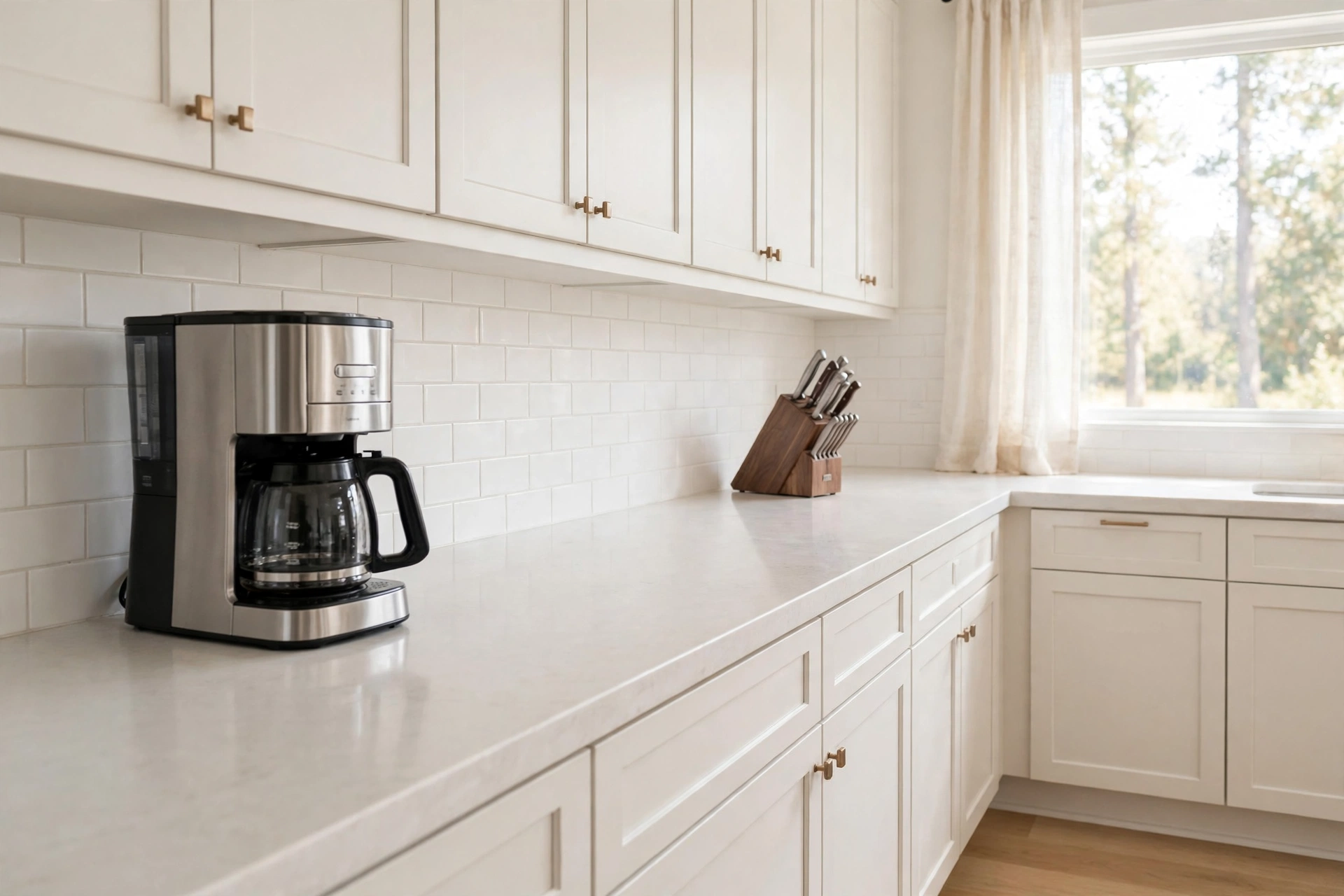
Kitchen counters are the most contested real estate in the house. Every small appliance, mail pile, and mystery gadget campaigns for a permanent spot — and once the counters fill up, cooking feels like clearing a construction site. But clear counters aren’t about having less stuff. They’re about a simple rule: only what you use daily earns counter space.
These are the kitchen counter organization ideas that keep counters clear: the counter audit, appliance triage, zone-based placement, and the two-minute reset that holds the line.
For the whole kitchen system — cabinets, pantry, and fridge — see our small kitchen guide and fridge zones.
The counter audit
Clear everything off. Every single item. Then put back only what passes the test:
- Daily use: coffee maker, kettle, knife block, cutting board — the things you touch every day stay.
- Weekly use: toaster, stand mixer (maybe) — these earn a cabinet spot, not counter space. Convenience is not the same as frequency.
- Monthly or less: the bread maker, the juicer, the fondue set — deep storage, high shelf, or out of the house.
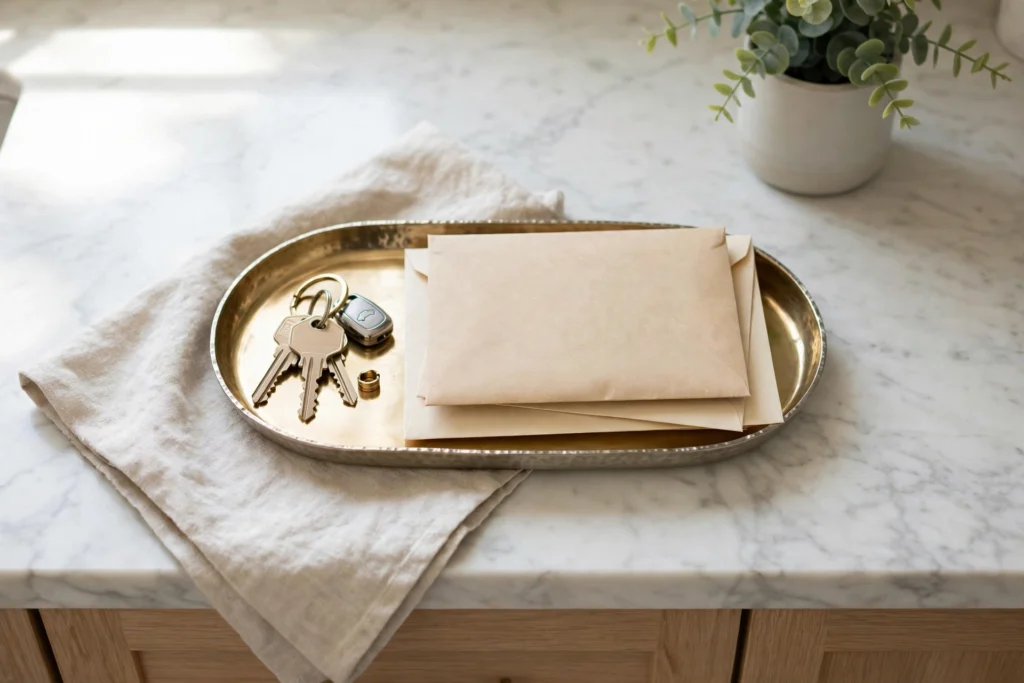
- Not kitchen items: mail, keys, sunglasses, the junk drawer overflow — relocate immediately. Counters are not a drop zone.
Appliance triage
- The one-appliance rule: if two appliances do the same job, one leaves. The air fryer and the toaster oven are having a turf war — pick a winner.
- Store by frequency: daily on the counter, weekly in an easy cabinet, monthly up high or in the pantry.
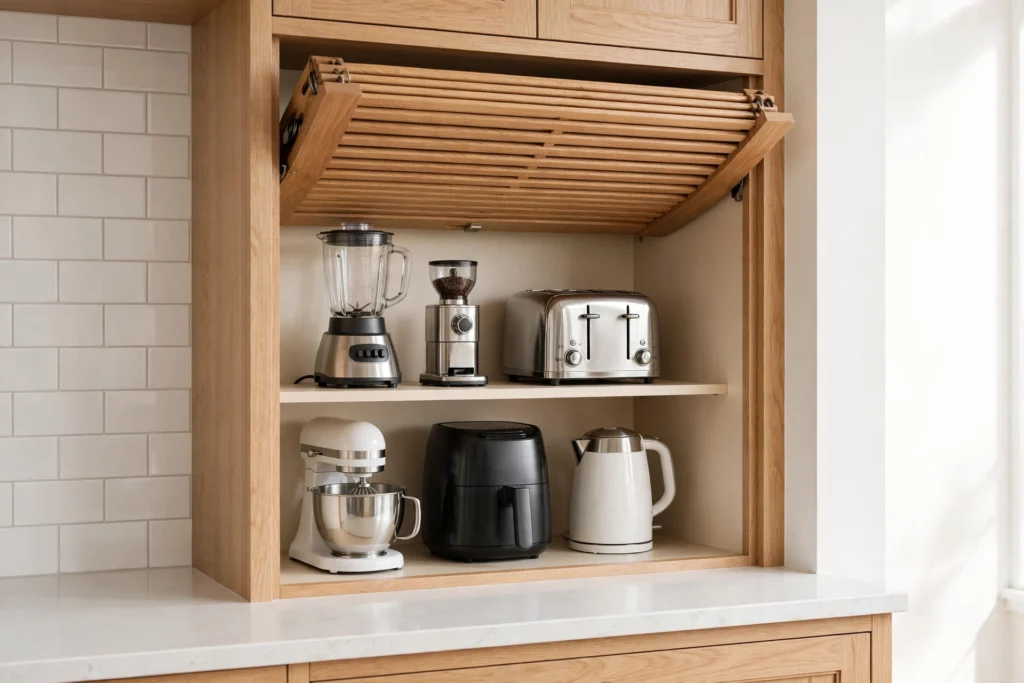
- The appliance garage: a cabinet with a lift-up or tambour door hides the daily appliances without the daily haul. Best of both worlds.
- Unplug the guilt: an appliance you keep “because it was expensive” but never use is expensive clutter. Sell it, donate it, free the counter.

Zone the counter
- Coffee station: machine, mugs, beans in one tight cluster — ideally near the pantry. One zone, no sprawl.
- Prep zone: clear stretch near the stove with the knife block, cutting boards, and oils. Nothing else lives here.
- Landing zone: one small tray by the entrance for the inevitable daily deposits (mail, keys). Contained, not scattered — emptied nightly.
- Nothing near the sink except soap and a drying rack. The sink area collects clutter fastest; defend it hardest.


Storage that clears counters
- Wall-mounted knife strip: frees the knife block’s footprint and looks better.
- Hanging utensil rail: spatulas and ladles on the wall by the stove, not in a crock eating counter space.
- Under-cabinet hooks and shelves: mugs under the cabinet, paper towels under the cabinet — vertical space is free real estate.
- A single fruit bowl: one beautiful bowl, not three. Produce on display is decor; produce scattered is mess.
- Drawer dividers for the overflow: the utensils and gadgets that left the counter need organized drawers, or they’ll migrate back.
Small kitchen counter ideas
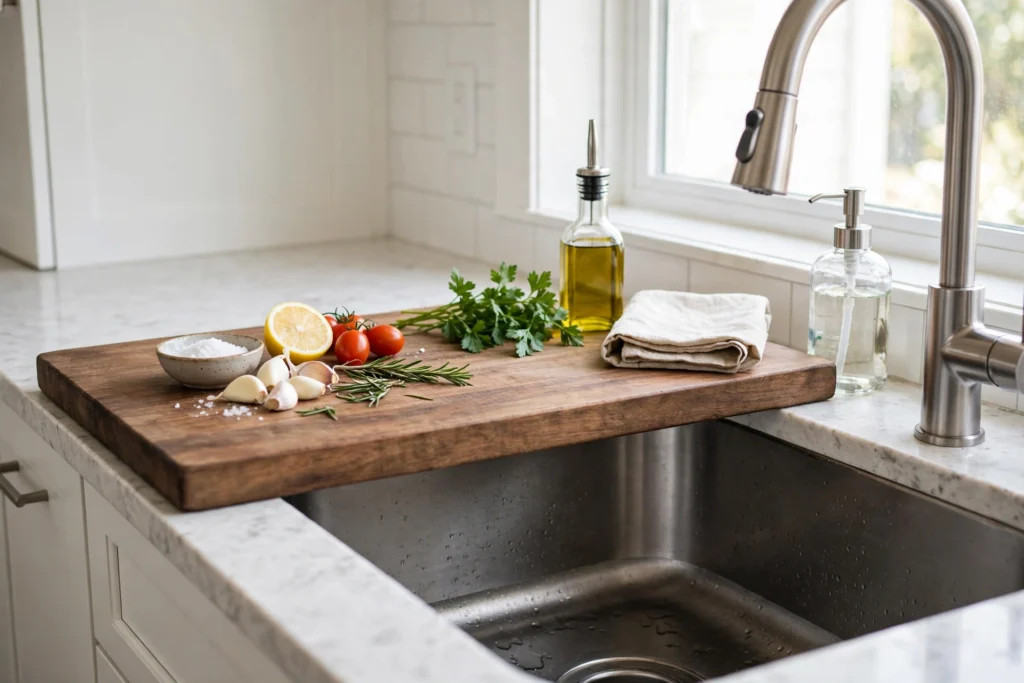
- Cutting board over the sink: instant extra prep space in a tiny kitchen.
- Fold-down or pull-out surfaces: a wall-mounted drop-leaf table adds counter when cooking, disappears after.
- Stove cover: a flat cover turns the stovetop into usable counter between meals.
- One in, one out: small kitchens can’t absorb new gadgets. Every arrival means a departure.

The two-minute counter reset
- Dishes into the dishwasher or sink — nothing dries on the counter.
- Appliances back to their zones.
- Landing tray emptied: mail to the action tray, keys to their home.
- Wipe the counters — clear counters get wiped; cluttered ones don’t.
After cooking and before bed. Two minutes, twice a day, and the counters never avalanche again.

Mistakes that refill counters
Decorating the counter. Three canisters, two plants, a sign that says “EAT” — decor is the fastest way to lose prep space. One beautiful item, max.
The “temporary” pile. There’s no such thing as temporary on a counter. It either has a home elsewhere or it leaves.
Storing weekly appliances on the counter. If you use it twice a week, it lives in a cabinet. Counter space is for daily use only.
No landing zone. Without one contained tray, the whole counter becomes the landing zone.
Frequently asked questions
What should stay on kitchen counters?
Only what you use daily: coffee maker or kettle, knife storage, cutting board, soap at the sink, and one contained landing tray. Everything else earns cabinet, pantry, or storage space.
How do I keep my kitchen counters clear?
Audit once (daily-use only stays), zone the counter (coffee, prep, landing), store weekly appliances in cabinets, and run the two-minute reset after cooking and before bed.
How do I organize a small kitchen with no counter space?
Cutting board over the sink, stove cover between meals, wall-mounted storage (knife strip, utensil rail, under-cabinet hooks), and ruthless one-in-one-out on gadgets.
Where do I put small appliances I don’t use daily?
Weekly-use in an easy-access cabinet, monthly-use on a high shelf or in the pantry, rarely-used in deep storage or out of the house. An appliance garage cabinet is ideal for daily appliances you want hidden.
Final thoughts
Clear counters come from one rule applied relentlessly: daily use earns the counter, everything else earns a home elsewhere. Audit once, zone it, reset twice a day. Cooking in a clear kitchen feels like a different life — because it is.