
Small kitchens get a bad reputation they don’t deserve. The problem usually isn’t the square footage — it’s that the kitchen is storing things it shouldn’t, in places that don’t make sense, with no system holding it together. Fix those three things and even the tiniest galley kitchen starts to feel capable.
These are the organization ideas that make the biggest difference in small kitchens: where to put things, which small upgrades punch above their weight, and the countertop rules that keep the whole room feeling bigger than it is.
Already tackled the pantry? Our small pantry organization guide pairs perfectly with this one. And if the whole house needs work, start with the room-by-room decluttering system.
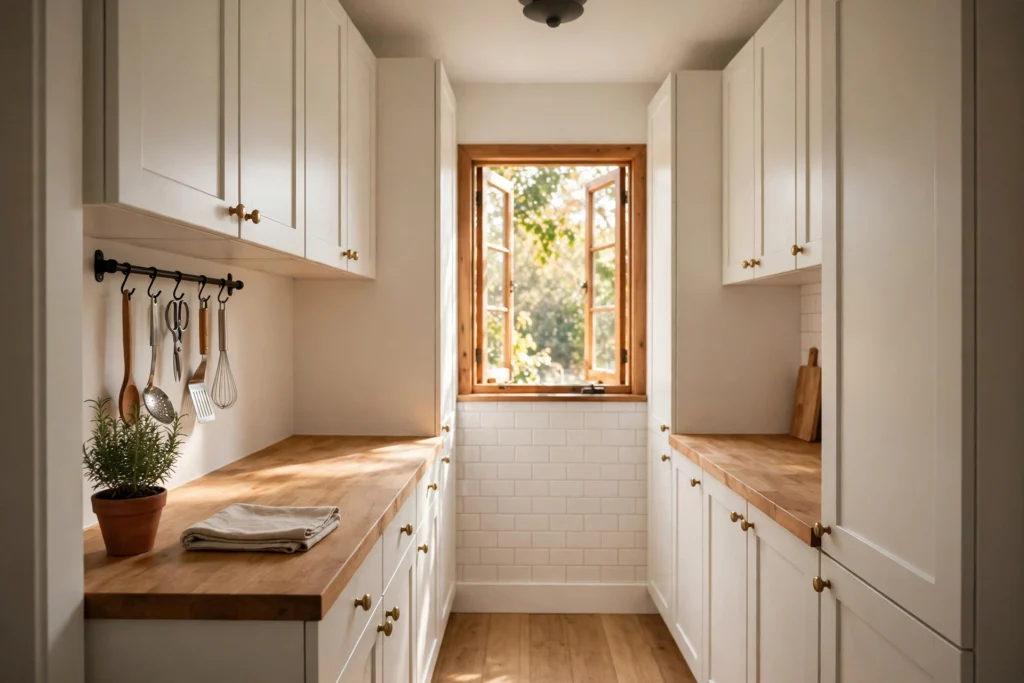
First: the 30-minute kitchen purge
Don’t organize a cluttered kitchen — you’ll just be arranging things you don’t need. Do this fast pass first:
- Pull out every duplicate: two peelers, three spatulas, the blender and the food processor you use twice a year. Keep the best one.
- Toss chipped dishes, warped pans, and anything with a wobble or a crack.
- Open the gadget drawer and be honest: if you haven’t used it in a year, it goes.
- Check the back of every cabinet for the “someday” items. Someday is now, and the answer is no.
Most small kitchens lose 20–30% of their storage to things nobody uses. Getting that space back is free, and it’s the highest-impact step in this entire guide.
Think in work zones
Professional kitchens are organized by task, not by shelf. Steal the idea: set up three zones and keep everything for each task inside its zone.
- Prep zone — near the main counter: knives, cutting boards, mixing bowls, spices.
- Cook zone — around the stove: pots, pans, cooking utensils, oils.
- Clean zone — around the sink: dish soap, drying rack, trash and recycling.
When every tool lives where it’s actually used, you stop crossing the kitchen forty times per meal — and putting things away becomes automatic because there’s only one logical home for each item.
14 small kitchen organization ideas
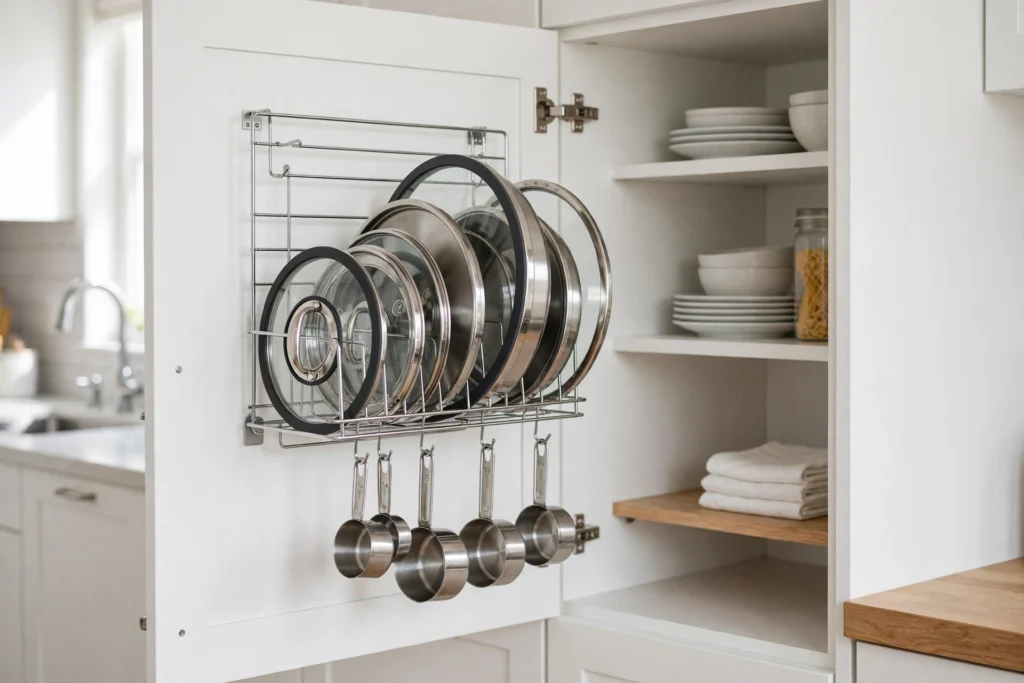
1. Put your cabinet doors to work
The inside of a cabinet door is some of the most underused space in a small kitchen. Mount a slim rack or a few adhesive hooks and suddenly there’s a home for pot lids, measuring cups, wraps, or spices — without sacrificing a single shelf.

2. Divide every drawer
An undivided drawer is just a horizontal junk drawer. Adjustable drawer dividers turn one chaotic space into compartments where everything has a place. The utensil drawer alone is worth doing today; you’ll feel the difference every time you cook.
3. Go vertical inside cabinets
Stacking wastes the top half of every cabinet. Shelf risers, stacking shelves, and under-shelf baskets reclaim that dead air — the same trick that transforms small pantries works everywhere in the kitchen.

4. Mount a magnetic knife strip
A knife block eats a full square foot of counter. A magnetic strip on the wall or the side of a cabinet holds the same knives in zero counter space — and it’s safer, since blades aren’t rattling around in a drawer.
5. Hang pots and pans
A wall-mounted rail or a ceiling rack frees an entire cabinet. If drilling isn’t an option (renters, this is for you), a heavy-duty tension rod inside a deep cabinet can hold spray bottles, or an over-the-door organizer can take the lids.
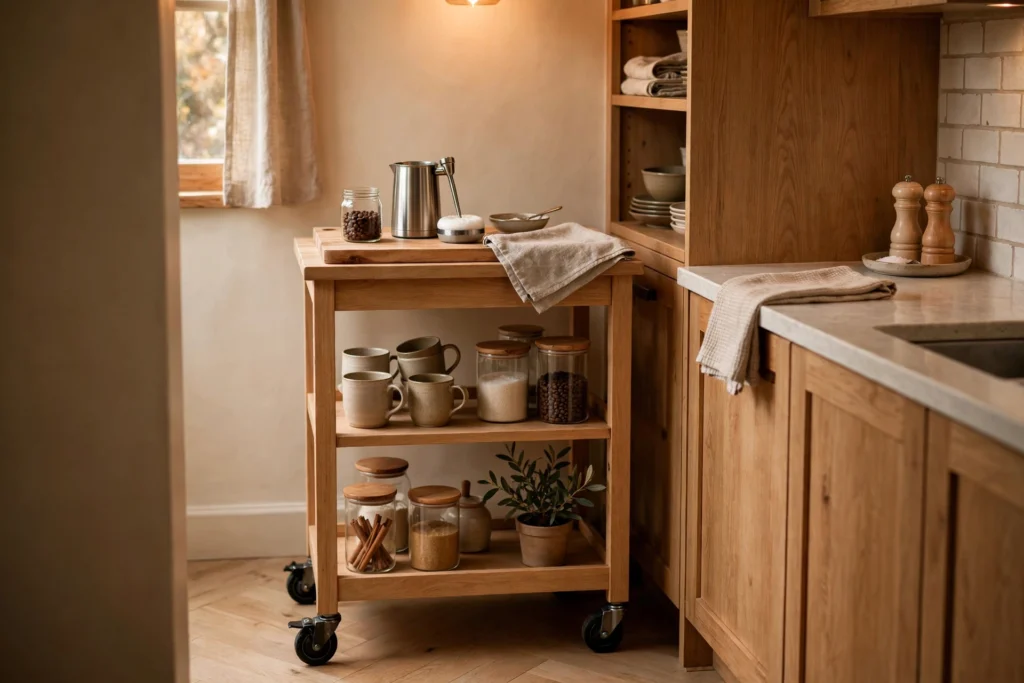
6. Roll in a kitchen cart
A slim rolling cart is the best friend of a small kitchen: extra prep surface, extra storage, and it tucks into a six-inch gap when you don’t need it. Use it as a coffee station, a produce cart, or overflow for the items that don’t fit anywhere else.
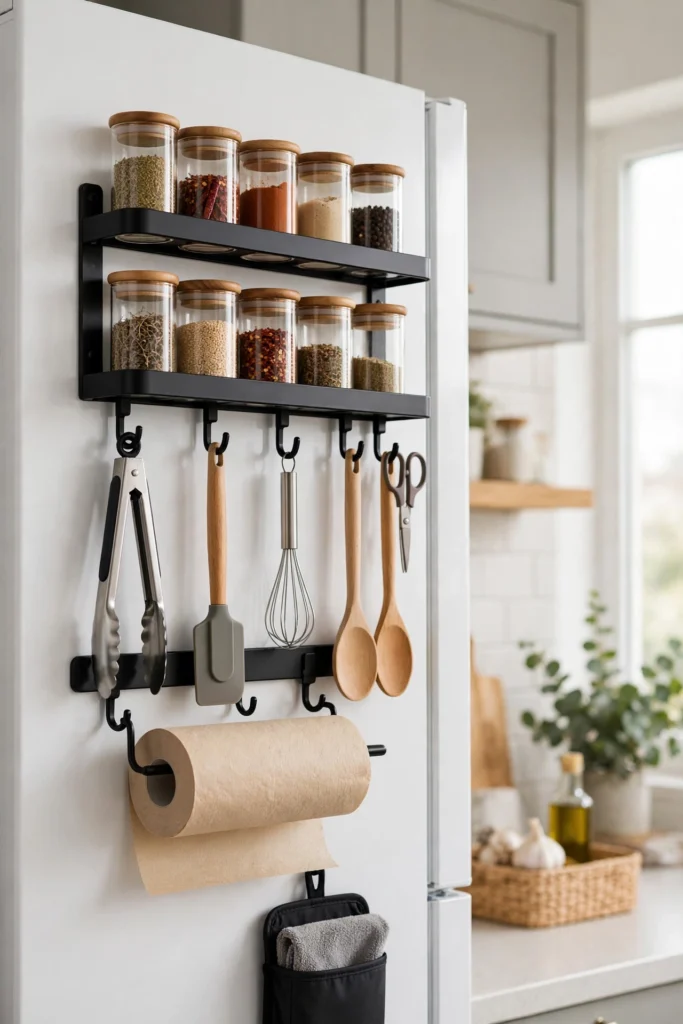
7. Use the sides of the fridge
Magnetic shelves and hooks on the side of the refrigerator create instant storage for spices, paper towels, or cleaning supplies. It’s dead space you’re already heating and cooling — might as well use it.

8. Install under-cabinet hooks
A row of small hooks under the wall cabinets holds mugs, measuring cups, or utensils right where you use them. Ten minutes with a drill (or adhesive hooks for renters) and a whole shelf’s worth of items moves off the counter.
9. Corral the cleaning supplies
Under-sink chaos deserves its own system: a small tension rod for spray bottles, a pull-out caddy for sponges and brushes, and a bin for the rest. Everything visible, everything reachable, no more avalanche when you need the dish soap.
10. Decant the bulky stuff
Flour, sugar, rice, and cereal take up far less room in square, stackable containers than in their original bags and boxes. Squares beat circles — they tessellate, so you lose none of the shelf to gaps.
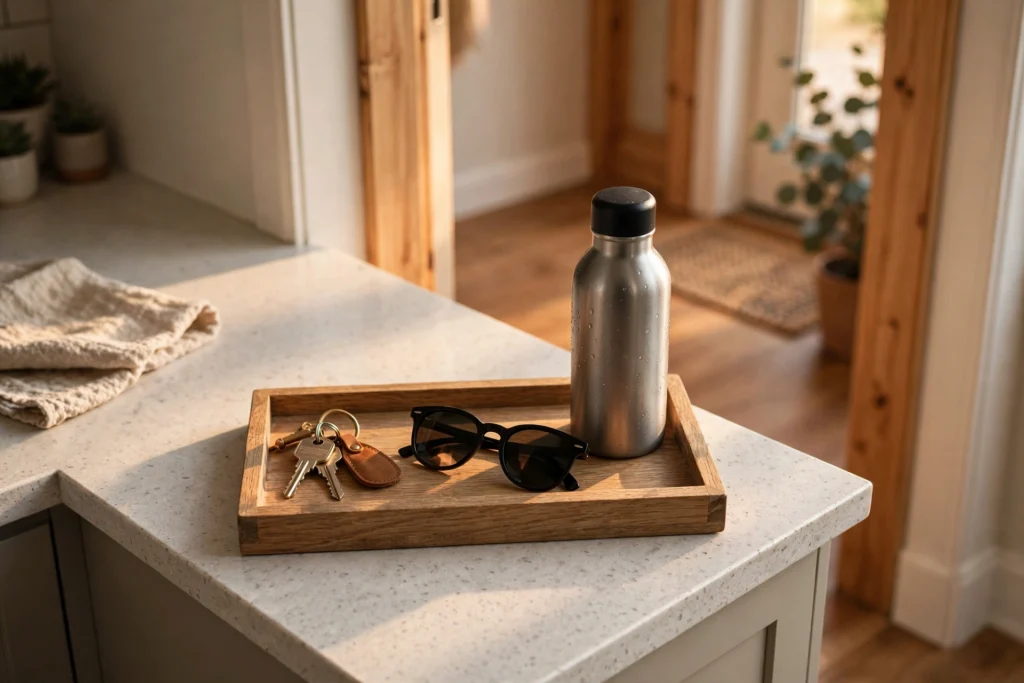
11. Create a landing strip
Every kitchen needs one designated spot for the daily churn: keys, mail, the water bottle. A small tray or wall-mounted organizer by the entrance keeps it contained. Without a landing strip, the “daily churn” colonizes every counter.
12. Store rarely-used items elsewhere
The turkey roaster, the fondue set, the giant stockpot — if you use it twice a year, it doesn’t deserve prime kitchen real estate. Top of a closet, a high garage shelf, under a bed. Your everyday kitchen should only hold everyday things.
13. Use clear bins in deep cabinets
Deep lower cabinets are black holes. Clear bins turn them into pull-out drawers: one bin per category, slide out what you need, slide it back. Label the fronts and the whole family can maintain it.
14. Fold down when you’re done
If counter space is truly precious, consider a wall-mounted drop-leaf table or a cutting board that fits over the sink. Extra prep space that disappears when dinner’s done is the ultimate small-kitchen luxury.
The countertop rules
Counters are the scarcest resource in a small kitchen, so they get rules:
- Daily-use only. If you don’t touch it every day, it lives in a cabinet. The stand mixer you use weekly? Cabinet.
- One appliance out, max two. Coffee maker plus one. Everything else gets put away after use.
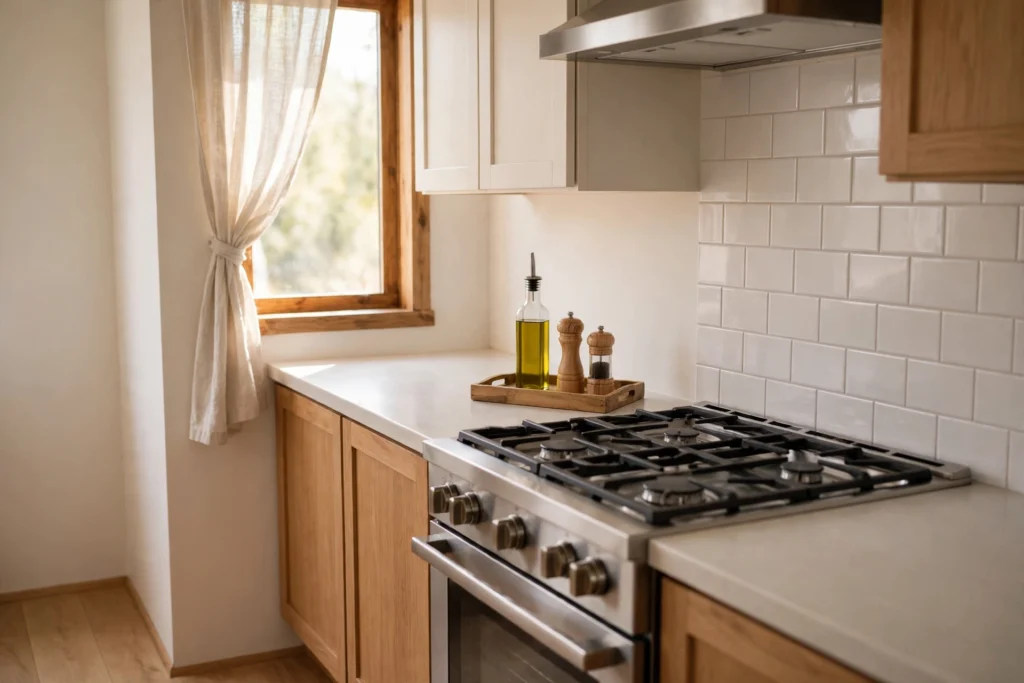
- Corral the small stuff. The olive oil, salt, and pepper you actually use daily can share one small tray — it looks intentional instead of scattered, and wiping the counter takes ten seconds.
- Clear it nightly. A two-minute reset before bed means you start every morning in a kitchen that feels twice as big.
Mistakes that keep small kitchens cramped
Storing aspirational items. The juicer for the juice cleanse, the bread maker for the sourdough era. If the era hasn’t started in a year, donate the equipment.
Buying organizers before purging. Measure the problem after the purge, not before. Most people need half the organizers they think they do.
Ignoring vertical space. Walls, cabinet doors, fridge sides, the gap between the fridge and the wall — small kitchens are won vertically.
One more “space-saving” gadget. The irony of small kitchens is how much space gets wasted on organizers that don’t fit the actual problem. Solve the specific annoyance, not the general vibe.
Frequently asked questions
How can I maximize storage in a very small kitchen?
Purge first (20–30% of most kitchens is unused stuff), then go vertical: cabinet-door racks, wall-mounted rails, magnetic strips, and under-shelf baskets. Zones keep what remains findable. These four moves solve the majority of small-kitchen storage problems.
Where should I put things I rarely use?
Outside the kitchen’s prime zones: top shelves, the top of a nearby closet, or a labeled bin in storage. The rule is simple — everyday items get the best spots, occasional items get the leftovers.
How do I keep kitchen counters clear?
The daily-use-only rule: if you don’t touch it every day, it doesn’t live on the counter. Corral the few daily items on a single tray, and do a two-minute reset every night.
What’s the best way to organize a rental kitchen I can’t drill into?
Tension rods, over-door organizers, adhesive hooks, magnetic fridge shelves, rolling carts, and freestanding shelf risers — all completely drill-free. Renters can get 90% of the way there without touching a wall.
Final thoughts
A small kitchen works when everything in it has earned its place and knows its zone. Purge the unused, zone by task, go vertical, and protect the counters. Do that, and the kitchen stops feeling like a compromise — it just feels like your kitchen.