Most closets aren’t too small. They’re just holding too many decisions — the jeans that almost fit, the sweater from three jobs ago, the “just in case” outfits that have survived four moves without being worn once. Decluttering a closet isn’t really about clothes. It’s about removing the decisions that slow down every morning.
This is a step-by-step system, not a motivational speech. Follow it in order, make the decisions once, and end the day with a closet where everything fits, everything works, and getting dressed takes five minutes.
Doing the whole house? Our room-by-room decluttering guide shows where the closet fits in the bigger plan.
Before you start: set up for success
Closet decluttering fails when people start pulling clothes out with no plan for the decisions. Set this up first — it takes ten minutes and saves hours.
- Bags and boxes: four of them, labeled Keep, Donate, Toss, and Relocate (things that belong in another room).
- A full-length mirror nearby for the try-on round.
- Snacks and water. Decision fatigue is real, and it’s worse when you’re hungry.
- A block of time: 2–4 hours for a standard closet. Don’t start at 9 PM.
- One rule: nothing goes back into the closet until every decision is made. The empty closet is the whole point.

Step 1: Take everything out
Yes, everything. Every hanger, every shelf, every shoe. Pile it on the bed in categories: tops, bottoms, dresses, outerwear, shoes, accessories. This is the only way to see the true scale of what you own — and the scale is usually the wake-up call.
While the closet is empty, wipe the shelves and vacuum the floor. You’ll never have better access than right now.

Step 2: Sort into four piles
Work category by category, item by item. Pick each piece up and ask the questions:
- Have I worn this in the last 12 months? If no, it needs an extraordinary reason to stay.
- Does it fit my body today? Not the aspirational body, not the 2019 body. Today’s.
- Would I buy it again right now? This cuts through sunk-cost thinking like nothing else.
- Is it damaged beyond reasonable repair? Stains, stretched elastic, broken zippers you’ve ignored for a year — toss.
Four piles, no fifth “maybe” pile. The maybe pile is how closets refill themselves. If you’re genuinely torn, there’s a tiebreaker: put it in a bag, date it, and store it out of sight. If you don’t reach for it in 30 days, donate the bag unopened.

Step 3: The try-on round
For everything in the Keep pile that you’re unsure about, try it on. Right now, in the mirror. Clothes you think fit and clothes that actually fit are often different things. This round usually removes another 10–20% — the items that looked fine on the hanger but don’t work on you.
Be especially honest about: work clothes for a job you no longer have, occasion wear for a life you don’t live, and anything you keep adjusting, tugging, or apologizing for while wearing.

Step 4: Handle the outflows immediately
Bag the Donate pile and put it by the front door — not “in the closet for later.” Schedule the drop-off or pickup today. Trash goes out today. Relocate items go to their rooms today. A decluttered closet with four bags sitting in the bedroom is not a decluttered closet.

Step 5: Put back only what earned its place
Now — and only now — organize what’s left. The golden rules:
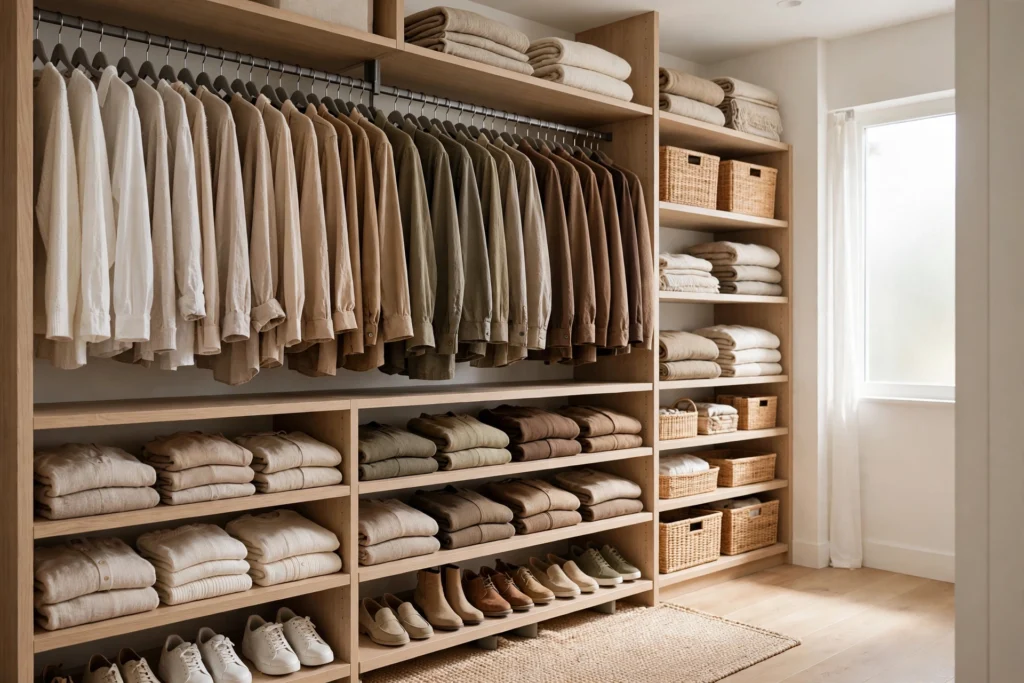
- Hang by category, then by color. All tops together, all pants together, light to dark within each group. You can find anything in seconds.
- One hanger, one item. Doubled-up hangers hide clothes and wrinkle them. Matching slim hangers save shocking amounts of rod space.
- Fold what’s foldable. Knits, tees, and jeans do better folded — file-fold them upright in drawers or bins so you can see every item at once.
- Zone the shelves. Top shelf: out-of-season and rarely used. Eye level: what you wear weekly. Low: shoes, bags, and everyday accessories.
- Give shoes a real home. A simple rack or clear boxes — not a pile on the floor. If you can’t see a pair, you won’t wear it.

The mistakes that refill closets
Keeping the “someday” clothes. The aspirational sizes, the just-in-case formalwear, the hobby gear for the hobby. They take up real space for an imaginary life. Keep one or two truly special pieces; release the rest.
Organizing before decluttering. Matching hangers and shelf dividers are wonderful — on a closet that’s already been edited. Buying them first just organizes the clutter.
Sentimental items mixed with daily clothes. The concert tee, the inherited scarf — they deserve a memory box, not a hanger. Sentimental items kept with everyday clothes get neither worn nor properly treasured.
No intake rule. A closet without an intake rule refills within months. The classic works: one in, one out. New shirt in, one shirt gets donated. Non-negotiable.

Keeping it that way
Maintenance is boring and that’s the point — it should be nearly invisible:
- One in, one out for all new clothing purchases.
- A seasonal 20-minute review when you swap seasons: anything you didn’t wear this season goes.
- A donation bag living in the closet — when you notice something you no longer love, it goes straight in the bag. When the bag’s full, it leaves the house.

Frequently asked questions
How long does it take to declutter a closet?
A standard reach-in closet takes 2–4 hours following this system; a large walk-in can take a full day. The try-on round is what takes the time — don’t skip it, since it’s where the hardest (and most valuable) decisions happen.
What should I do with clothes that are still good but I don’t wear?
Donate or consign them promptly. Good condition means someone else can use them now — every month they sit in your closet, they help no one and cost you space and mental energy.
How do I declutter sentimental clothing?
Keep a small memory box for the truly irreplaceable pieces, and photograph the rest before letting them go. The memory lives in the photo and the story, not in a sweater taking up shelf space for a decade.
How many clothes should I actually keep?
There’s no magic number — it depends on your climate, lifestyle, and laundry rhythm. A useful test: if you did laundry weekly, could you go two weeks without repeating or stressing? That’s roughly your right-sized wardrobe.
Final thoughts
A decluttered closet pays you back every single morning: less deciding, less digging, less “I have nothing to wear” in front of fifty hangers. Do the hard decisions once, set the one-in-one-out rule, and the closet stays solved.